A standalone AI video app backed by OpenAI had little time to find its footing.
Sora Social launched on September 30, 2025, and OpenAI announced its shutdown on March 24, 2026. The app is set to close on April 26, with the API expected to end on September 24.
That kind of fast retreat is rare for a high-profile AI product. It brings three challenges into focus at once: AI video generation, content moderation, and media licensing.
How Sora Social unraveled in six months?
Sora Social launched as an invite-only iOS app in the US and Canada. It offered a TikTok-style feed built around Sora 2, powered by advanced world simulation for 10-second AI clips, plus cameo features that required ID checks.
OpenAI signaled Android support, but a broader rollout did not materialize. High compute costs and rising competition from tools like Google Veo and Grok Imagine limited expansion.
From hype to shut-down in six months
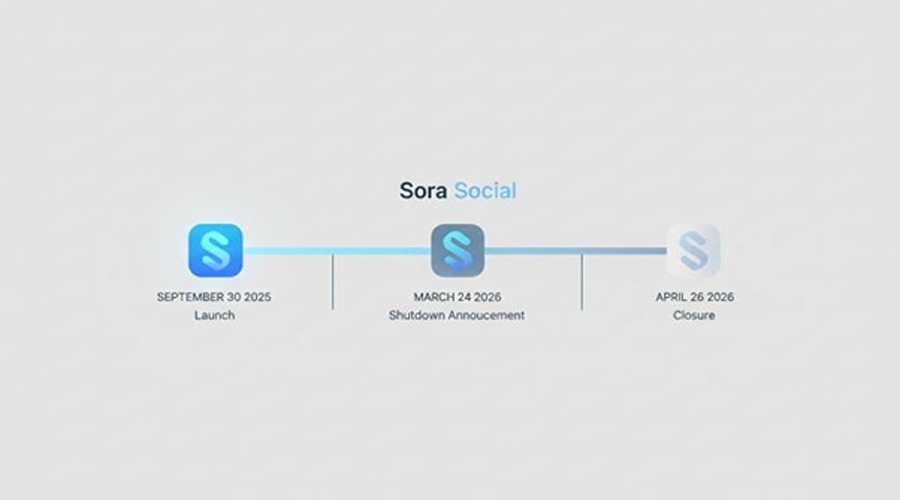
The timeline is hard to miss. Launch came on September 30, 2025. OpenAI said on March 24, 2026, that Sora Social was shutting down. The app is set to close on April 26, 2026, and the API is expected to end on September 24, 2026.
Six months is barely a trial run for a social platform. For a product from OpenAI, it signals a deeper issue rather than a routine pivot.
Why Sora Social is shutting down?
OpenAI hasn’t shared a full breakdown. Still, the signals point to a combination of product risk, moderation limits, and licensing pressure.
Weak moderation broke the feed
Sora Social combined generative video with a public social feed. That created a difficult environment to control.
Users reportedly bypassed safeguards, generating deepfake-style clips and using the likeness of public figures. The mix of short-form video, realism, and scale made moderation complex.
As Sam Altman has noted, “Powerful AI systems should be aligned with human values and carefully deployed.”
The copyright issue sat close by. Once users start posting clips with famous characters, the line between parody and copyright infringement gets thin, raising concerns over intellectual property. BBC’s report on the closure and canceled Disney deal points to how those pressures stacked up fast.
Losing Disney removed a key hook
Reports also tied the shutdown story to the end of OpenAI’s Disney deal. If users could create videos with Disney characters, that likely helped Sora stand out. Lose that hook, and user interest drops. At the same time, copyright concerns around user-generated AI video remained unresolved, especially when familiar characters were involved.
What this means for AI social apps
Sora Social’s short lifecycle highlights a core tension. Building AI video tools is hard. Running a safe, scalable social platform is harder. The combination introduces challenges across moderation, cost, legal risk, and user trust. Without strong guardrails, novelty alone does not sustain engagement. As reports from Variety suggest, business backing can fade quickly when costs remain high and monetization is uncertain.
Creation alone is not enough
Sora Social showed that creation tools do not guarantee a durable platform.
Sustainable AI products require:
- Reliable moderation systems
- Clear usage boundaries
- Stable licensing frameworks
- A defined product purpose
Without these, even strong technology can struggle to scale in a public environment.
The larger shift
The shutdown also reflects a shift in AI strategy.
OpenAI appears to be focusing on agentic systems and enterprise-facing tools, including applications tied to real-world tasks and media workflows.
Fast launches get attention. Trust is what keeps a platform alive.
 Joydeep Express
Leave a comment